Sharing COVID Information
December 8, 2020
When I started this blog in March to keep people up to date, I think we all hoped a few months of masking and we’d be through the worst, even if the vaccine would take longer to produce. Now, on December 8th, 2020, vaccines are starting to get emergency use authorization, but it will still be many months until we all can be vaccinated. In the meantime, the cold weather is driving people indoors, outdoor dining is becoming less and less of an option, and the COVID case numbers are escalating.
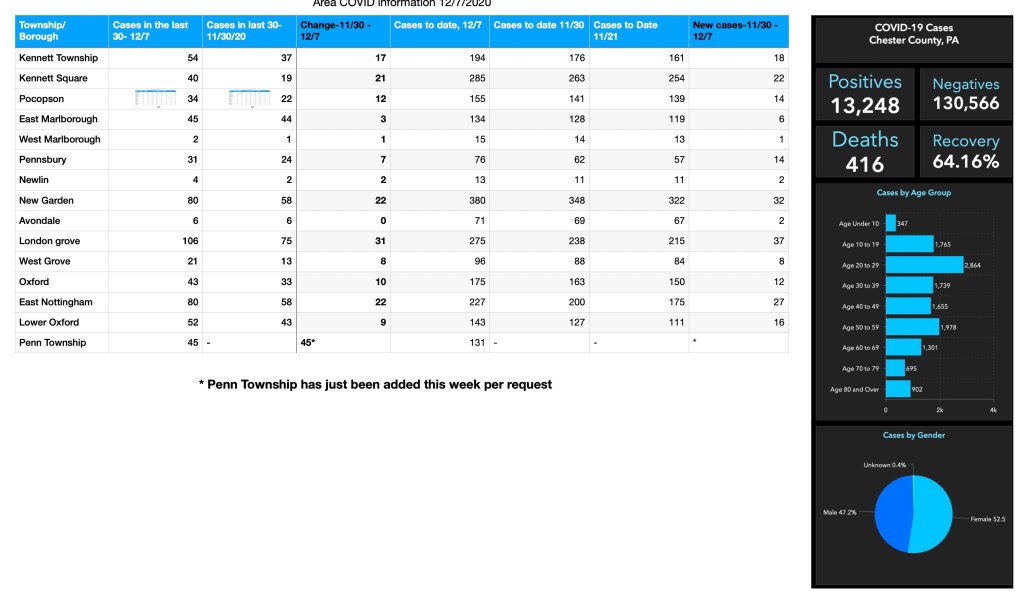
As of this morning, 12/8, 10 AM, there have been 201 cases in the Township and 293 in the Borough, well over a hundred more in each since July, but alarmingly, big jumps in case numbers recently.
This means we’re looking at a holiday season where gatherings are challenging, and the opportunity to just window shop and choose special items from local stores needs to be done online rather than in person.
We urge you to look online to continue to support local merchants during the season. That can be getting take out from our excellent restaurants, or choosing special gifts, but shopping online instead. We ordered our favorite Christmas in Kennett tea from Mrs. Robinson’s and had it delivered by mail, for example.
Even Phillips Mushrooms will do curb-side pickup for fresh mushrooms, so you can make excellent mushroom soup, or mushroom duxelles sauce for holiday dinners using the freshest mushrooms available from our local farmers.
Why is this still Dangerous and How to Stay Safe
Many people fixate on the fact that the death rate from COVID is low- 2-3% of cases- However, it has already claimed over 280,000 americans this year. People in every age group- people with and without pre-existing conditions. The largest danger from the virus is its long-lasting effects for some people. (Detailed in depth below) In addition to the issues listed below, there have been reports that COVID infection could age your brain by 10 years, and even cause erectile dysfunction in part because of the vascular damage being done by COVID. That’s a lot of risk to take- disability and potential death- or- wear a mask, wash and disinfect your hands frequently, and stay home as much as you can.
Coronavirus can stay infectious in the air for up to 16 hours after someone with an infection has been in the space. That’s why being indoors during the cold weather is so dangerous. It’s not just the people in the grocery/store/restaurant/office right now, but EVERYONE who has been there in the past 16 hours may have left droplets still floating around in the air.
An article in The Lancet, one of the world’s premiere medical journal states:
On Oct 5, 2020, the CDC updated their COVID-19 webpage to say that there is growing evidence that COVID-19 infection can occur from airborne exposure to the virus under certain circumstances. Cases of transmission from people more than 2 m apart have occurred but in enclosed spaces with poor ventilation, and typically with extended exposure to an infected person of more than 30 min. The CDC have been clear to point out that most infections are spread through close contact and that airborne transmission is not the primary route of transmission.Whether droplet or airborne transmission is the main route, the risk of infection is known to be much lower outside where ventilation is better. As winter approaches in the northern hemisphere, the opportunity to socialise and exercise outdoors becomes more challenging and concerns are growing over the increased risk of transmission of COVID-19. Public health guidance now needs to advise people how to navigate risk in indoor settings and wearing facemasks is becoming mandatory in many countries for travelling on public transport, indoor shopping, and gatherings. Facemasks and shields offer protection from larger droplets but their effectiveness against airborne transmission is less certain. Advice on spending time indoors should also focus on improved ventilation and avoiding crowded spaces.”
What to do:
Wear a mask whenever you are outside of your home.
Wear a mask in your home when workmen, delivery people, or even visitors come by. Outside is safer, but if you eat in a tent, that’s the same as eating indoors.
Eating at a restaurant involves being unmasked in an indoor environment with others for a prolonged period of time. It puts you and others at increased risk. Please consider take-out instead.
Even when meeting friends outdoors, if you are within 6- 12 feet, stay masked. Bring a mask with you at the park and raise it as you approach others. It’s just good manners and keeps everyone safe.
The vaccine is coming soon, although we have no word yet from the Commonwealth on what the distribution strategy will be, or timing. You do not want to be the last person to get this potentially debilitating disease before the vaccine came, because you got impatient or thought it couldn’t happen to you.
The Mayo Clinic on Long Term Effects of COVID
On its website, the Mayo Clinic states the following about long-term effects of COVID infection:
Older people and people with many serious medical conditions are the most likely to experience lingering COVID-19 symptoms, but even young, otherwise healthy people can feel unwell for weeks to months after infection. The most common signs and symptoms that linger over time include:
- Fatigue
- Shortness of breath
- Cough
- Joint pain
- Chest pain
Other long-term signs and symptoms may include:
- Muscle pain or headache
- Fast or pounding heartbeat
- Loss of smell or taste
- Memory, concentration or sleep problems
- Rash or hair loss
Organ damage caused by COVID-19
Although COVID-19 is seen as a disease that primarily affects the lungs, it can damage many other organs as well. This organ damage may increase the risk of long-term health problems. Organs that may be affected by COVID-19 include:
- Heart. Imaging tests taken months after recovery from COVID-19 have shown lasting damage to the heart muscle, even in people who experienced only mild COVID-19 symptoms. This may increase the risk of heart failure or other heart complications in the future.
- Lungs. The type of pneumonia often associated with COVID-19 can cause long-standing damage to the tiny air sacs (alveoli) in the lungs. The resulting scar tissue can lead to long-term breathing problems.
- Brain. Even in young people, COVID-19 can cause strokes, seizures and Guillain-Barre syndrome — a condition that causes temporary paralysis. COVID-19 may also increase the risk of developing Parkinson’s disease and Alzheimer’s disease.
Blood clots and blood vessel problems
COVID-19 can make blood cells more likely to clump up and form clots. While large clots can cause heart attacks and strokes, much of the heart damage caused by COVID-19 is believed to stem from very small clots that block tiny blood vessels (capillaries) in the heart muscle.
Other parts of the body affected by blood clots include the lungs, legs, liver and kidneys. COVID-19 can also weaken blood vessels and cause them to leak, which contributes to potentially long-lasting problems with the liver and kidneys.
Problems with mood and fatigue
People who have severe symptoms of COVID-19 often have to be treated in a hospital’s intensive care unit, with mechanical assistance such as ventilators to breathe. Simply surviving this experience can make a person more likely to later develop post-traumatic stress syndrome, depression and anxiety.
Because it’s difficult to predict long-term outcomes from the new COVID-19 virus, scientists are looking at the long-term effects seen in related viruses, such as the virus that causes severe acute respiratory syndrome (SARS).
Many people who have recovered from SARS have gone on to develop chronic fatigue syndrome, a complex disorder characterized by extreme fatigue that worsens with physical or mental activity, but doesn’t improve with rest. The same may be true for people who have had COVID-19.
Many long-term COVID-19 effects still unknown
Much is still unknown about how COVID-19 will affect people over time. However, researchers recommend that doctors closely monitor people who have had COVID-19 to see how their organs are functioning after recovery.
Many large medical centers are opening specialized clinics to provide care for people who have persistent symptoms or related illnesses after they recover from COVID-19.
It’s important to remember that most people who have COVID-19 recover quickly. But the potentially long-lasting problems from COVID-19 make it even more important to reduce the spread of the disease by following precautions such as wearing masks, avoiding crowds and keeping hands clean.
July 2, 2020
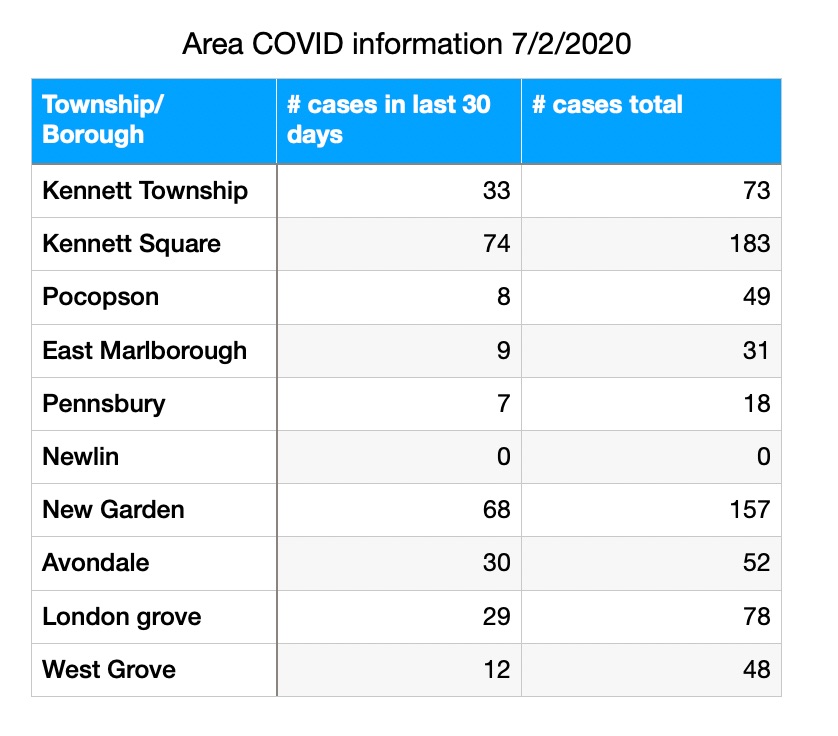
Gov. Wolf has issued an order that everyone must wear a mask when they leave home. Pennsylvania has also issued travel advisories for residents traveling to states currently experiencing severe outbreaks, including Arizona, Texas, Florida, North Carolina and others.
Wear A Mask in Public
Members of the public are required to wear homemade cloth or fabric masks. Save surgical masks and N95 respirators for our health care workers and first responders.
Remember this saying: “My mask protects you, your mask protects me.”
Wear a mask whenever you leave your home
June 20, 2020- Happy Father’s day Weekend!
ANNOUNCEMENTS: We moved a lot of the past updates to an archive page you can get to from the top navigation. The page was getting too long and needed to be shortened, but all the information is still available on the archived page.
This week’s news– Chester County is slated to go to “Green” on June 26.
What Does this mean? Click here to see all phases on the PA.gov site. Green phase details below:
| Green Phase |
|---|
| Work & Congregate Setting Restrictions |
| Continued Telework Strongly Encouraged Businesses with In-Person Operations Must Follow Updated Business and Building Safety Requirements All Businesses Operating at 50% Occupancy in the Yellow Phase May Increase to 75% Occupancy Child Care May Open Complying with Guidance Congregate Care Restrictions in Place Prison and Hospital Restrictions Determined by Individual Facilities Schools Subject to CDC and Commonwealth Guidance |
| Social Restrictions |
| Large Gatherings of More Than 250 Prohibited Masks Are Required When Entering a Business Restaurants and Bars Open at 50% Occupancy Personal Care Services (including hair salons and barbershops) Open at 50% Occupancy and by Appointment Only Indoor Recreation, Health and Wellness Facilities, and Personal Care Services (such as gyms and spas) Open at 50% Occupancy with Appointments Strongly Encouraged All Entertainment (such as casinos, theaters, and shopping malls) Open at 50% Occupancy Construction Activity May Return to Full Capacity with Continued Implementation of Protocols |
- All businesses must follow CDC and DOH guidance for social distancing and cleaning
- Monitor public health indicators, adjust orders and restrictions as necessary
Chester County Case Updates- June 20, 2020
- Avondale 50
- Kennett Square. 164
- New Garden. 142
- West Grove 47
- London Grove 70
- Kennett Township 59
- East Marlborough 25
- Pennsbury 17
- Pocopson 45
- New Castle County, DE 4,522 or 78/10,000- Delaware also recommends face coverings in public in all places.
Access to antibody testing data- click here
Data for Long Term Care Facilities in Chester County dashboard
May 30, 2020
There has been a local spike in cases which you can see comparing today’s data to that on 5/20. More testing is available- KACS will be doing free testing for the next few weeks on Friday at their Cedar Street location in Kennett Square- it will take a few days to get results back. I will also be posting some new research papers here and on the page labelled Research.
This week we also reached a grim milestone of over 100,00 americans losing their lives to COVID-19. Please do not underestimate the virus and how contagious it is as the County prepares to move into the “yellow” phase with more businesses resuming operations. Please wear.a mask in public- and remember to be effective, it needs to cover your nose and mouth.
Current Data: 2708 positives, 12,523 negations and 251 deaths in Chester County
Kennett Square: 79 cases
Kennett Township: 34 cases, 1 death
New Garden: 74 cases, 1 death
East Marlborough 22 cases
Pennsbury 11 cases
Avondale. 14 cases
Pocopson 42 cases, 5 deaths
London Grove 40 cases
New research:
New England Journal of Medicine: Surgical masks provide source control for respiratory viruses. https://www.jwatch.org/na51322/2020/04/13/surgical-masks-provide-source-control-respiratory-viruses
NIH: Rapid systemic review of efficacy of Face Masks:
https://www.ncbi.nlm.nih.gov/pmc/articles/PMC7191274/.
Conclusion
The study suggests that community mask use by well people could be beneficial, particularly for COVID-19, where transmission may be pre-symptomatic. The studies of masks as source control also suggest a benefit, and may be important during the COVID-19 pandemic in universal community face mask use as well as in health care settings. Trials in healthcare workers support the use of respirators continuously during a shift. This may prevent health worker infections and deaths from COVID-19, as aerosolisation in the hospital setting has been documented.
Mayo Clinic: How much protection do face masks offer? Excerpts below
https://www.mayoclinic.org/diseases-conditions/coronavirus/in-depth/coronavirus-mask/art-2048544
Cloth masks
While surgical and N95 masks are in short supply and must be reserved for health care providers, cloth masks are easy to find and can be washed and reused.
Asking everyone to wear cloth masks can help reduce the spread of the coronavirus by people who have COVID-19 but don’t realize it. And countries that required face masks, testing, isolation and social distancing early in the pandemic seem to have had some success slowing the spread of the virus.
Cloth masks are cheap and simple to make. Instructions are easy to find online. Masks can be made from common materials, such as sheets made of tightly woven cotton. The CDC website even includes directions for no-sew masks made from bandannas and T-shirts. Cloth masks should include multiple layers of fabric.
How to wear a cloth face mask
Cloth face masks should be worn in public settings where social distancing measures are difficult to maintain, such as in grocery stores, especially in areas of significant community-based transmission.
Here are a few pointers for putting on and taking off a cloth mask:
- Place your mask over your mouth and nose.
- Tie it behind your head or use ear loops and make sure it’s snug.
- Don’t touch your mask while wearing it.
- If you accidentally touch your mask, wash or sanitize your hands.
- Remove the mask by untying it or lifting off the ear loops without touching the front of the mask or your face.
- Wash your hands immediately after removing your mask.
- Regularly wash your mask with soap and water in the washing machine. It’s fine to launder it with other clothes.
Finally, here are a few face mask precautions:
- Don’t put masks on anyone who has trouble breathing, or is unconscious or otherwise unable to remove the mask without help.
- Don’t put masks on children under 2 years of age.
- Don’t use face masks as a substitute for social distancing.
Latest Press Conference with Chester County and Delaware County
The counties are now working together and held a joint press conference on 3/19/2020 at 11 am. You can watch it by clicking here.
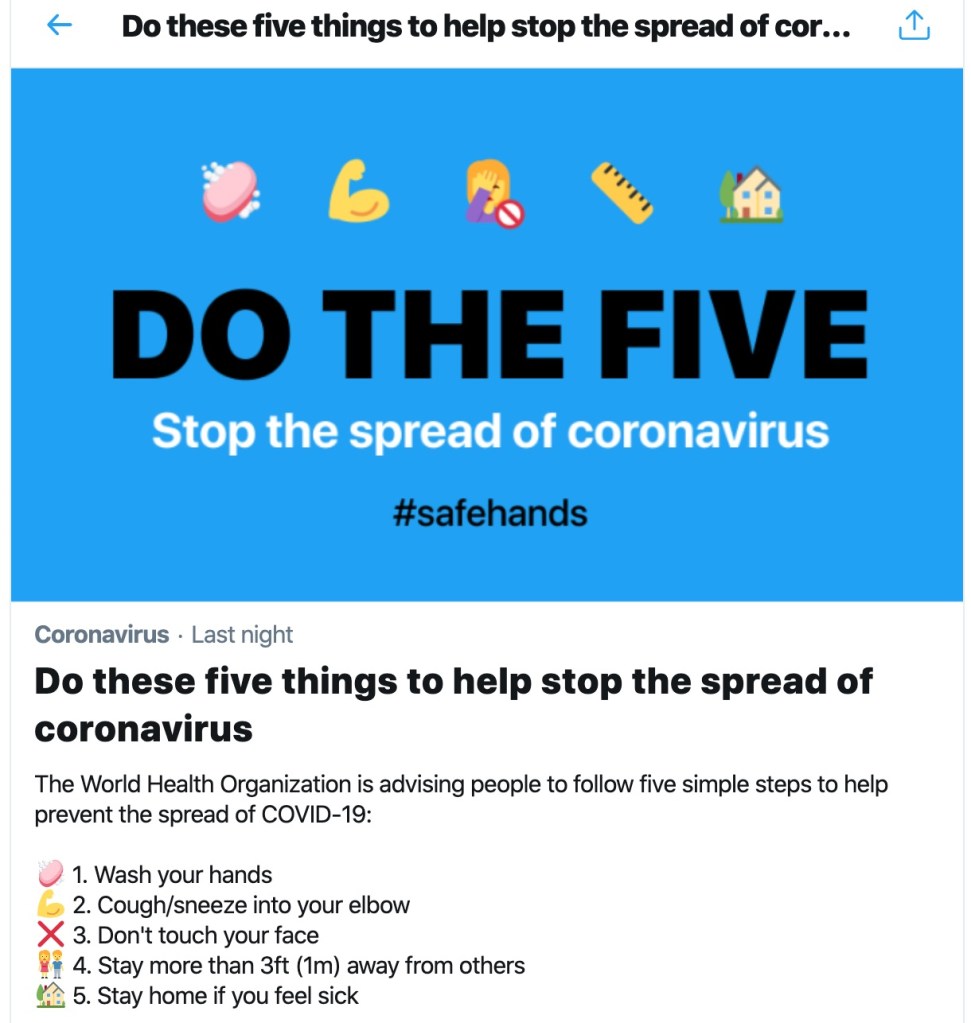
Latest News- We’ll post the latest news here as we get it and will write longer pieces on the blog (You can find that under “about” in the Nav.) In order to keep up, we’re updating the local and regional pages as the highest priority- please check those first.
Please bear with us- as we started this site on 3/18/20 and are working to curate information so folks without Social Media Access can get up to date information.
Click here to subscribe- you’ll get updates by email when we post new things.
 Kennett COVID Information